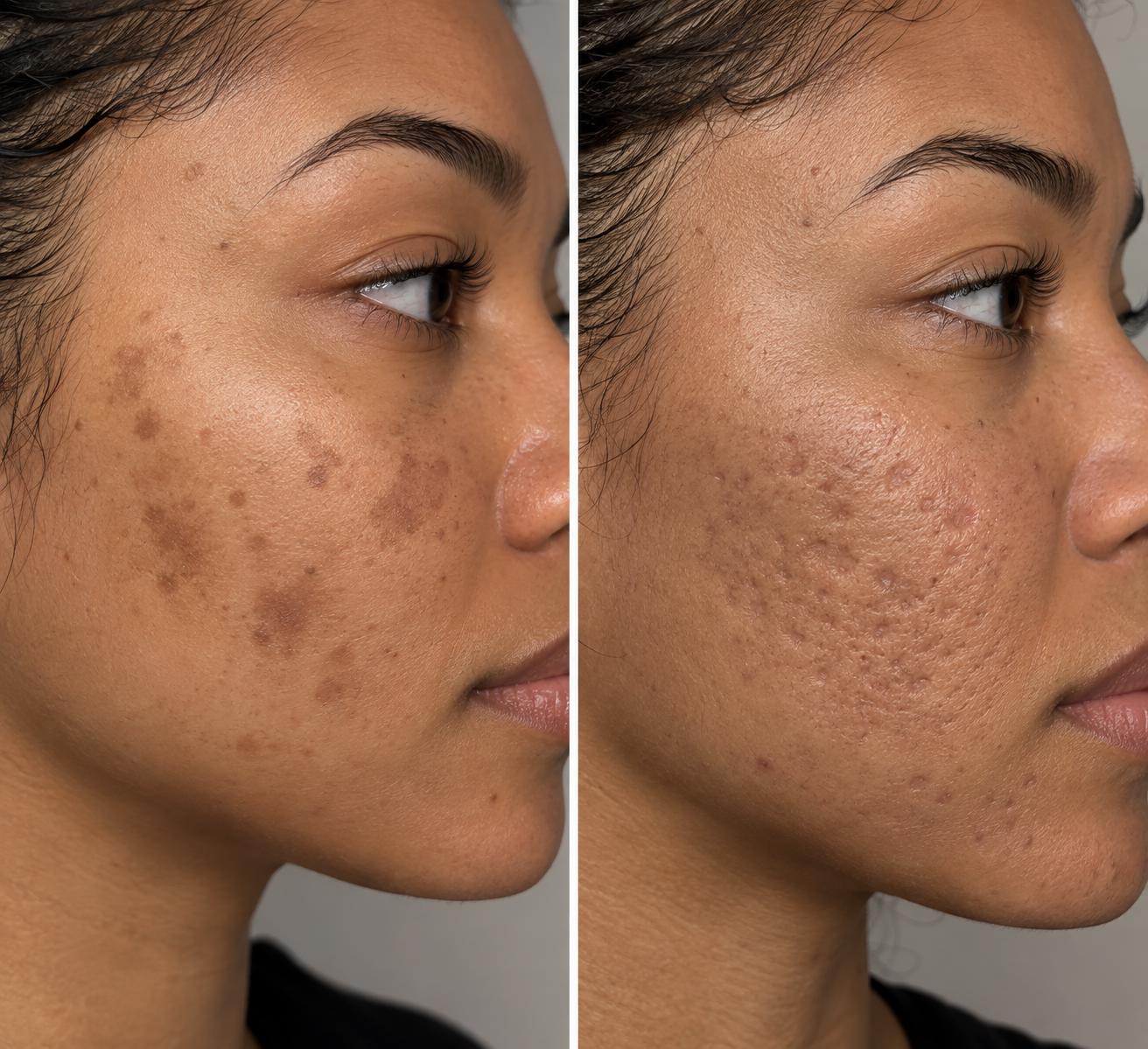
That dark spot left behind after a breakout might not be a scar at all.
One of the most common misconceptions in skincare is calling every mark left behind by acne an “acne scar.”
But there’s an important difference between post-inflammatory hyperpigmentation (PIH) and true acne scarring — and understanding that difference can completely change how you approach treatment.
First: What Is Hyperpigmentation?
Hyperpigmentation is a change in skin color caused by excess melanin often left behind after inflammation, irritation or injury.
When acne becomes inflamed, the skin can respond by producing or depositing more pigment. Once the breakout is gone, you may be left with a brown, gray-brown, or darker mark where the pimple used to be.
This is called post-inflammatory hyperpigmentation, or PIH.
The skin itself may still feel completely smooth.
That’s the key distinction.
If you run your fingers over the area and the skin is smooth, but you can see a dark mark, you’re likely looking at pigmentation rather than a textural scar.
PIH can gradually fade over time, although the timeline varies depending on factors such as the depth of pigment, the degree of inflammation, sun exposure, and individual skin characteristics.
So What Is an Acne Scar?
An acne scar is a lasting change in the skin’s structure that occurs when inflammatory acne damages the deeper layers of the skin and alters how collagen is formed during healing.
This can result in depressed scars, such as ice-pick, boxcar, and rolling scars, or raised scars caused by excess scar tissue.
Some common types include:
Ice-pick scars
Small, narrow depressions that extend deeper into the skin.
Boxcar scars
Depressed areas with more defined edges.
Rolling scars
Shallow depressions that can create an uneven or “wave-like” appearance.
There are also raised acne scars, where excess scar tissue creates a bump rather than a depression.
Unlike a flat dark mark, these changes involve the actual structure of the skin.
This is why treating pigmentation and treating textural scarring aren’t exactly the same thing.
Why Does This Matter?
Because the treatment approach should match what you’re actually treating.
If your primary concern is pigmentation, your treatment plan may focus on reducing inflammation, supporting skin renewal, protecting against UV exposure, and carefully addressing excess pigment.
If you’re dealing with textural acne scarring, treatment may require a completely different approach and a longer-term treatment plan.
And sometimes?
You have both.
It’s very common to have a combination of active acne, post-inflammatory pigmentation, and textural scarring at the same time.
Skin of Color & Hyperpigmentation
This is especially important when treating deeper skin tones.
Skin of color can be more susceptible to developing visible post-inflammatory pigmentation after inflammation or irritation.
That means an aggressive treatment isn’t automatically a better treatment.
When pigmentation is a concern, the goal should be to improve the skin without creating unnecessary inflammation that can contribute to more discoloration.
This is why individualized treatment matters.
Your skin should be evaluated based on its current condition, history, sensitivity, and goals — not simply treated according to a generic protocol.
And Then There’s Picking…
Let’s talk about one of the biggest contributors to lingering marks:
Picking your skin.
I know the temptation is real.
You see a pimple and want it gone immediately. But squeezing, picking, or repeatedly irritating an inflamed lesion can create additional injury and inflammation.
And that can increase the likelihood of a lingering mark.
Instead of asking:
“How do I get rid of this pimple tonight?”
Try asking:
“How can I calm this inflammation without creating another problem?”
Your future skin will thank you.
Don’t Forget Your SPF
If you’re working on hyperpigmentation, daily sun protection matters.
UV exposure can contribute to pigmentation and can make existing discoloration more difficult to manage.
That means your treatment plan shouldn’t stop at the treatment room.
Professional treatments and a consistent home-care routine work together.
Think of it this way:
Treat → Protect → Maintain → Reassess
Consistency is often more valuable than constantly switching from one aggressive treatment to another.
So… Is It a Scar or a Dark Mark?
Here’s a simple way to think about it:
Flat + darker than your surrounding skin = likely pigmentation
Indented or raised + textural change = likely scarring
But skin isn’t always that simple.
If you’re unsure what you’re seeing, a professional skin assessment can help determine whether you’re primarily dealing with pigmentation, texture, active acne, or a combination.
Your Treatment Should Start With the Problem — Not the Trend
There isn’t one “best” acne-scar treatment for everyone.
The right approach depends on what you’re actually trying to change.
For pigmentation, professional treatments may include appropriately selected exfoliating or brightening approaches.
For textural scarring, a qualified medical professional may recommend treatments designed to address changes in the skin’s structure.
And if active acne is still present, that may need to be addressed before focusing heavily on residual marks or scarring.
Your skin doesn’t need the most aggressive treatment. It needs the right treatment.
Ready to understand what your skin actually needs?
At Lynsthetics, we believe every treatment should start with understanding the skin first.
Whether you’re dealing with dark marks, acne, uneven texture, or a combination of concerns, a professional skin assessment can help determine the most appropriate next step.
Explore Chemical Peels →
Explore Facial Services →
Book a Skin Consultation →
⸻
THE LYNSTHETICS JOURNAL
Skin education, treatment guides & expert insight.
Written by Lynette Nuñez
Esthetician • Phlebotomist • Laser Technician
Founder of Lynsthetics
This article is intended for general skincare education and does not replace individualized medical advice or evaluation by a qualified healthcare professional.